
Luzerne County Court Records After a Jail Arrest
After a Luzerne County arrest, the usual path runs from booking to preliminary arraignment before a magisterial district judge, then to magisterial district court and, for Common Pleas criminal matters, the Court of Common Pleas. The county directory identifies Samuel M. Sanguedolce, Esquire, as District Attorney and chief law enforcement officer of Luzerne County.
The custody side and the court side answer different questions. Jail inmate records are the starting point for current custody, booking, housing, and release questions at Luzerne County Correctional Facility. Jail roster mugshots explains why the county site should not be treated as a booking-photo gallery. Court records after an arrest show docket number, charges, bail actions, hearings, warrants, dispositions, sentences, and financial obligations.
How to Find Luzerne County Court Records After an Arrest
The official public court portal is Pennsylvania Unified Judicial System Case Search. It is the correct place to look for formal court charges after a Luzerne County jail arrest. Jail booking information may reflect the arrest; UJS dockets reflect the court case.
- Gather the person's full legal name, approximate arrest date, arresting agency, and any booking number, OTN, complaint number, docket number, citation number, or incident number.
- Open UJS Case Search and search by Participant Name with Luzerne County selected when a county filter is available.
- If paperwork provides a docket, OTN, complaint, citation, or incident number, search with that identifier to avoid common-name matches.
- Open the docket and read the charge list, grading, bail entries, hearing dates, warrant events, dispositions, sentencing entries, and financial obligations.
Recent court-office entries may lag. UJS notices identify juvenile, expunged, limited-access, and other restricted records as examples of matters that may not display. If a case should exist but is missing, recheck later and verify with the originating court office.
The UJS Case Search screen is the source shown below. The form supports several search paths when a jail record gives an OTN or complaint number instead of a Common Pleas docket.
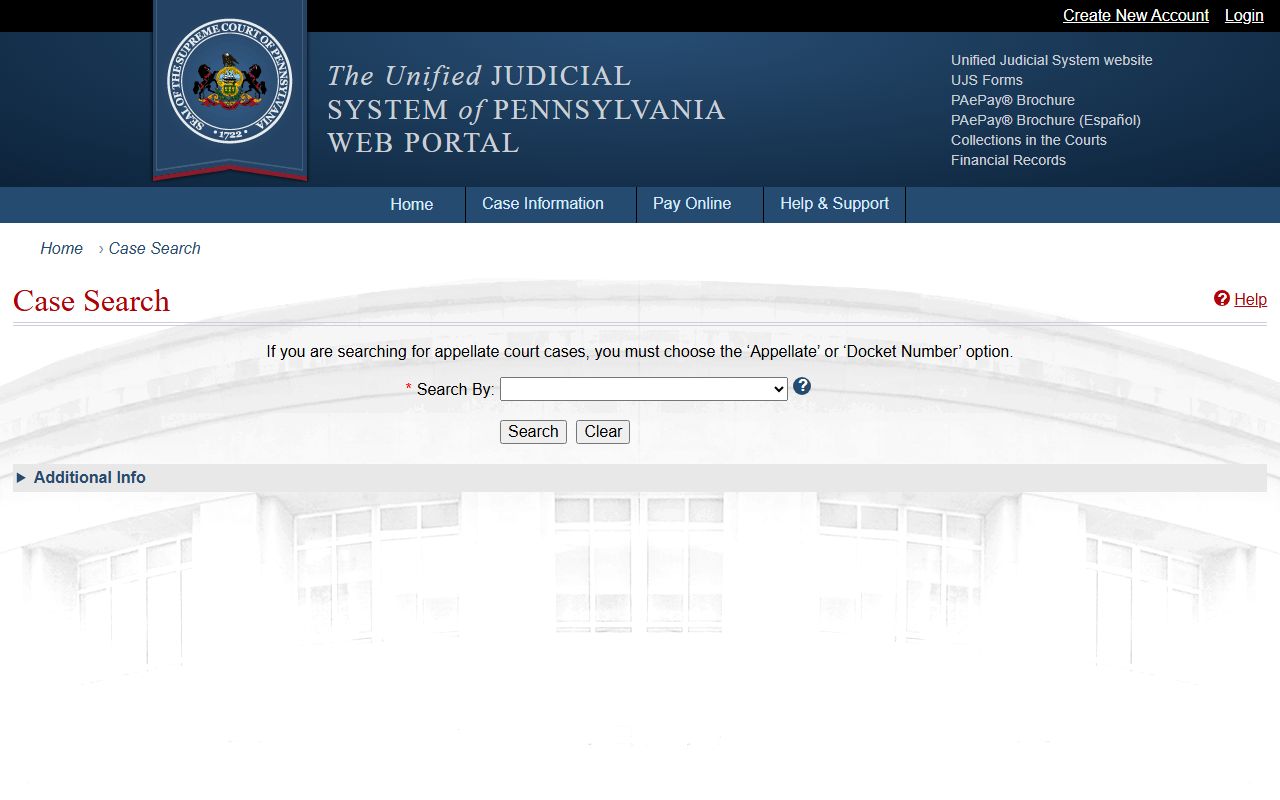
Use the narrowest identifier available first. A docket-number or OTN search usually produces cleaner results than a name search.
UJS Search Fields for Court Records After an Arrest
UJS Case Search lets users change the search type before entering a query. For Luzerne County criminal cases, docket numbers may start with an MJ prefix for magisterial district matters or a CP-40-CR pattern for Court of Common Pleas criminal dockets.
| Field Label | Type | Required | Options / Format Notes |
|---|---|---|---|
| Search By | Dropdown | Yes | Appellate, Attorney, Calendar Event, Citation Number, Complaint Number, Date Filed, Docket Number, Incident Number, Organization, OTN, Parcel, Participant Name, SID. |
| Advanced Search | Checkbox | Optional | Displays for many search types and can expose county or date filters. |
| Docket Number | Text | Required when selected | UJS examples include MJ-51301-TR-0009999-2017 and CP-25-CR-0009999-2017; Luzerne Common Pleas criminal dockets commonly use CP-40-CR format. |
| Citation Number | Text | Required when selected | Use the full citation number, including any dash shown on paperwork. |
| OTN | Text | Required when selected | Helpful for matching arrest paperwork or a jail booking to the first court filing. |
| SID | Masked text | Required when selected | The portal displays a segmented numeric pattern. |
| SSN | Masked text | Required when selected | Public users should avoid entering an SSN unless it is required and appropriate for the transaction. |
| Date Filed Start Date | Date | Conditional | Use mm/dd/yyyy; required for date-filed searches and some advanced searches. |
| Date Filed End Date | Date | Conditional | Use mm/dd/yyyy; the portal may cap some date ranges. |
| County | Dropdown | Conditional / optional | Select Luzerne when narrowing a participant-name or date search to local court records. |
| Search / Reset | Buttons | n/a | Search runs the query; Reset clears the form. |
How Charges Get Filed After an Arrest: Complaint, Information, and Indictment
Booking starts the custody record, but the charge record begins with court paperwork. A criminal complaint often starts the case at the magisterial level and ties the arrest to an OTN or complaint number. If the matter moves forward in Common Pleas, the District Attorney may file a criminal information after preliminary proceedings. An indictment is a grand-jury charging document used where that procedure applies.
| Document | Filed By | Common Use | What to Compare |
|---|---|---|---|
| Criminal complaint | Law enforcement or prosecution through the magisterial court process | Initial misdemeanor or felony allegations after arrest | OTN, complaint number, first listed charges, preliminary arraignment, and bail. |
| Criminal information | Luzerne County District Attorney | Formal Common Pleas charging document after preliminary proceedings | Whether charges were held, amended, added, reduced, or withdrawn before Common Pleas filing. |
| Indictment | Grand jury process where used | Cases using a grand-jury charging route | Docket entries and later filings that identify the charges actually proceeding in court. |
Follow the OTN or docket from the first court filing, then compare it with later Common Pleas entries. That is where many differences between arrest paperwork and court records become clear.
Charge Status and What It Means
Charges can change while a case moves through court. A booking record may show what the person was arrested for, while the court docket shows what prosecutors filed and what the judge later accepted, dismissed, or sentenced. Treat each count separately because one charge may be dismissed while another remains pending or ends in a plea.
| Status | What It Means |
|---|---|
| Pending | The charge is still active on the docket and has not reached a final disposition. |
| Amended / Reduced | The filed charge changed, often by grading, statute, count language, or negotiated disposition. |
| Withdrawn | The prosecution did not proceed on that charge at that stage, though other counts may remain. |
| Dismissed | The court dismissed the charge, usually by order or after a hearing or motion. |
| Nolle Prosequi | The prosecutor formally chose not to pursue the charge, subject to court procedure. |
| Guilty / Plea / Convicted | The charge resulted in a conviction through plea or verdict and may be followed by sentencing entries. |
Bond and Release After an Arrest
Pennsylvania bail is controlled by the court, not by the jail website. After a Luzerne County arrest, bail decisions commonly appear around preliminary arraignment or later hearings. UJS dockets may show bail type, amount, conditions, and changes, and PAePay Bail is available for eligible cases or payment plans. Verify with the responsible court office before paying.
| Bail / Release Term | How It Works |
|---|---|
| Release on recognizance / nonmonetary conditions | The court releases the person based on a promise to appear or compliance with conditions, without a cash payment. |
| Monetary bail | The court sets an amount that must be posted before release under the court order. |
| Percentage / cash bail | Payment rules depend on the specific court order and instructions from UJS or the Clerk of Courts. |
| Surety bail | A third party or bail agent may be involved where Pennsylvania practice and the court order allow it. |
| No bail / denied bail | The person remains in custody unless a court changes the order. |
| Detainer / hold | A county, state, federal, probation, parole, or immigration hold can prevent release even if local bail is posted. |
No official Luzerne County jail page reviewed for the research published a separate bail-window schedule, accepted jail-lobby payment methods, or bondsman list. Bail is set and documented by the court, while the jail releases only after paperwork and holds permit release.
Warrants That Lead to an Arrest
The Luzerne County Sheriff's Warrants Division handles bench warrants issued through the Luzerne County court system and coordinates with other law-enforcement agencies. The Sheriff's Department main number is 570-825-1651, and the anonymous warrant tip line is 888-796-5519.
UJS Case Search is useful for warrant events, bail changes, and failures to appear. CRIMEWATCH pages from participating agencies, including Hazleton Police, may show official police-published warrant posts, but they are not a complete sheriff warrant database. The sheriff's page warns that the department does not call people and demand payment to resolve warrants.
Charges vs. Convictions in Court Records After an Arrest
An arrest and a filed charge are not the same as a conviction. A charge is an accusation being tested in court. A conviction follows a guilty plea, guilty verdict, or other final adjudication on that count. This distinction matters in any background-check context.
| Charge | Conviction | |
|---|---|---|
| Stage | Accusation filed in the court case | Final result by plea, verdict, or adjudication |
| Proof level | Supported by probable cause or charging procedure | Requires proof beyond a reasonable doubt or a legally valid plea |
| Record meaning | Shows what was alleged and prosecuted | Shows what the person was found or admitted guilty of |
| Can change? | Yes, charges may be amended, withdrawn, dismissed, or refiled | Changes usually require later court action, appeal, or post-disposition relief |
Sealed vs. Expunged Court Records After an Arrest
Pennsylvania public access is shaped by the Right-to-Know Law, CHRIA, court access rules, juvenile confidentiality, expungement, and limited-access procedures. A record that disappears from public search is not always erased from every government system.
| Sealed / Limited Access | Expunged | |
|---|---|---|
| Public visibility | Hidden from ordinary public access or limited by court rule or statute. | Removed or treated as erased for the covered record category. |
| Government access | May remain available to courts, law enforcement, or authorized agencies. | Access is more restricted and depends on the expungement order and governing law. |
| Common reason | Limited-access eligibility, juvenile status, privacy rules, or sealed proceedings. | Dismissal, withdrawal, acquittal, eligible summary matters, or another qualifying disposition. |
| What to do | Verify with the court office before assuming no case exists. | Use the court process and consult legal counsel when eligibility is uncertain. |
DA Records, Right-to-Know Requests, and Access Limits
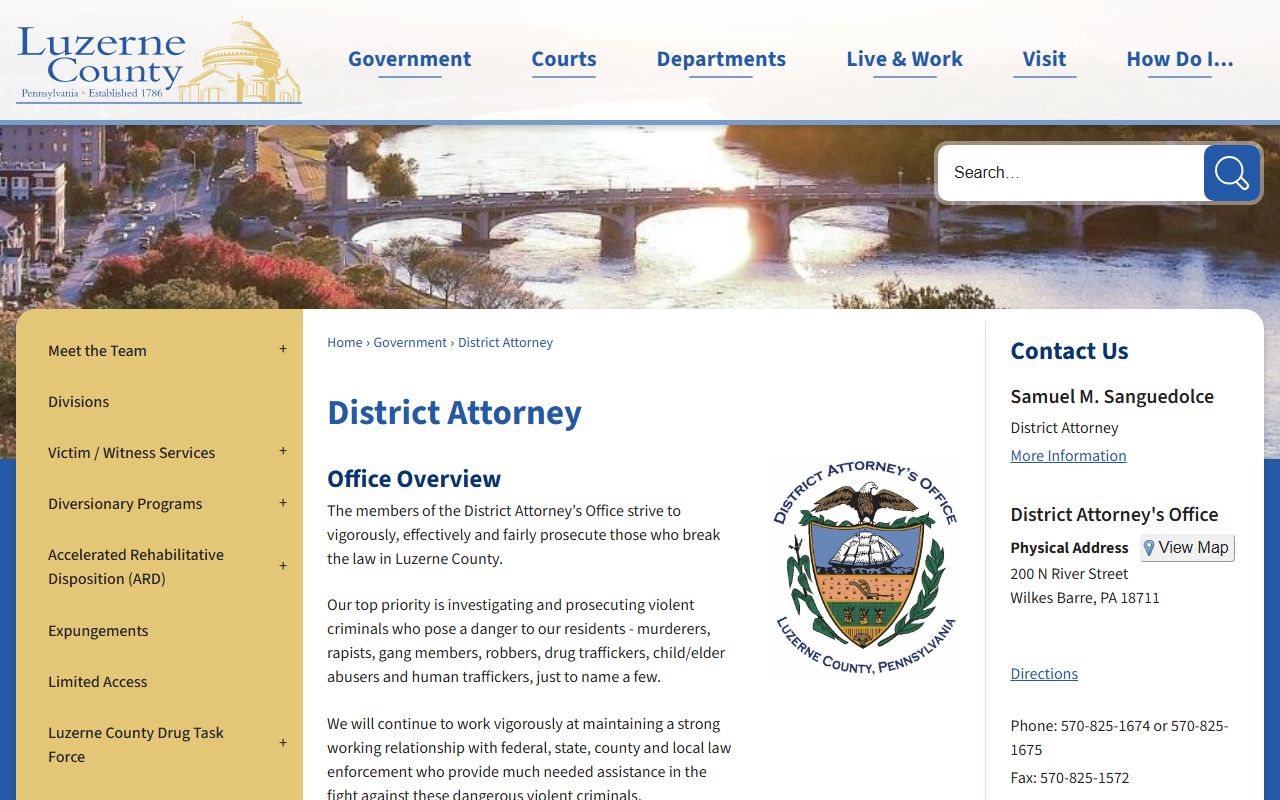
The Luzerne County District Attorney's Office is at 200 N River Street, Wilkes-Barre, PA 18711, phone 570-825-1674 or 570-825-1675, and is listed as open Monday through Friday, 8:30 a.m. to 4:30 p.m., excluding holidays. The official DA page identifies the office and leadership, while DA Right-to-Know requests are routed separately from general county requests.
Carl Frank, Assistant District Attorney, is identified as District Attorney Open Records Officer at 200 North River Street, Wilkes-Barre, PA 18711, with email DARighttoKnow@luzernecounty.org. Anthony Cardone, Assistant District Attorney, is listed as the DA appeals officer for RTK denials.
For non-court agency records, Pennsylvania's Right-to-Know Law, Act 3 of 2008, 65 P.S. Section 67.101 et seq., presumes many state and local agency records are public unless an exemption or other law applies. Exemptions can cover investigative, security, personal, and noncriminal investigative records. Luzerne County also has a Right-to-Know request page for county records.
Background Check Considerations
Casual court lookup is different from a regulated background check. Pennsylvania CHRIA, including 18 Pa.C.S. Chapter 91 and Section 9125, governs dissemination and certain uses of criminal-history information. Federal FCRA rules may also apply when a consumer report is involved.
Important: This site is not a consumer reporting agency and must not be used for employment, credit, housing, insurance, or other FCRA-covered decisions.
Restricted Court Records After an Arrest in Luzerne County
Not every arrest-linked record is public online. Juvenile matters, sealed charges, expunged cases, limited-access cases, active investigative records, privacy-protected information, and CHRIA-restricted materials may be withheld or redacted. County jail, sheriff, DA, and court offices may also keep separate records, so a missing UJS result does not automatically prove that no arrest, warrant, or agency record ever existed.
When a court case is missing, search UJS again by a different identifier, verify with the court office, contact the relevant agency for non-court records, and use the correct Right-to-Know process. For current custody, return to the jail rather than relying on the court docket alone.